
If you want to lose weight and keep it off, the answer isn’t another diet or stronger willpower, it’s lasting behaviour change.
The best way to lose weight and keep it off is to change the habits, thoughts and behaviours that drive your eating, so healthier choices become more natural instead of feeling like a daily battle. When your relationship with food changes, maintaining your weight becomes much easier because you’re no longer relying on motivation alone.
I wish I had a pound for every time someone I’ve worked with has said to me,
“I can lose weight. I just can’t keep it off.”
Over the years I’ve heard it thousands of times. Sometimes people tell me they’ve tried every diet imaginable. Sometimes they’re frightened to try again because they’re convinced they’ll end up back where they started.
One person summed it up perfectly:
“I’ve been dieting most of my life and never keep it off.”
Another said:
“Everything else I’ve tried failed.”
And perhaps the one that touches me most:
“I am so scared of failing.”
If any of those words sound familiar, I want you to know something: you are not unusual, and you’re certainly not alone.
After more than 15 years helping people change their relationship with food, I’ve become convinced that the problem isn’t that people don’t know enough about healthy eating.
Most of us know vegetables are good for us, and that ultra-processed foods aren’t. We know exercising more benefits our health. But knowing has never really been the problem, the real question is this:
Why do we keep doing the things we know we don’t want to do?
That’s the question that first drew me into behaviour change. Because if losing weight was simply about information, very few of us would struggle.
Instead, millions of intelligent, capable people find themselves trapped in the same exhausting cycle:
Lose weight.
Regain it.
Blame yourself.
Promise that Monday will be different.
Every time the cycle repeats, confidence takes another knock. And eventually, many people stop trusting themselves around food. But I don’t believe that’s because they’ve failed, I believe they’ve been trying to solve the wrong problem.
Most diets focus on changing what you eat.
Very few help you change the habits, thoughts and automatic behaviours that influence why you eat.
That’s why so many people can lose weight… but struggle to keep it off. This article isn’t another diet plan, or a list of foods to avoid.
Instead, I’ll explain why lasting weight loss has felt so difficult in the past, and why it becomes much more achievable when you stop fighting yourself and start changing the behaviours underneath.
Related: How to stop food cravings
What is behaviour change?
Behaviour change is the process of gradually changing the habits, routines and thought patterns that influence how, when and why you eat.
Instead of relying on willpower every day, healthier choices become increasingly automatic. You’re no longer forcing yourself to make the “right” decision each time food appears. You’re building habits that make those choices feel more natural.
That’s the difference between losing weight for a few weeks and learning how to keep it off for years.
Why Do So Many People Regain Weight?
Can I ask you a question? Have you ever reached your target weight, only to feel a tiny knot of anxiety instead of excitement?
You’re pleased you’ve done it, but part of you is already wondering,
“How am I going to keep this up?”
If so, you’re in very good company. One member of the Slimpod community put it like this:
“It’ll all come back on as it always does if I don’t make big changes.”
That sentence says so much. Not just about weight, but about hope, fear and years of trying.
Nobody regains weight because they wake up one morning and decide they’d quite like to undo all their hard work. Life simply starts happening again: work gets busy, your family needs you, you’re stressed, tired. You go on holiday.
The carefully followed plan becomes harder to follow, and if your old eating habits are still sitting quietly underneath, they simply return. That’s where I think so many of us have been let down by dieting.
We’ve been taught to focus almost entirely on food:
Eat this.
Avoid that.
Count these.
Measure those.
But eating isn’t driven by hunger alone, it’s influenced by habit, routine, stress levels and emotions.
If you’ve automatically reached for biscuits every afternoon for years, that behaviour isn’t happening because you’ve consciously decided to do it every day, your brain has simply learned the pattern. And brains are designed to repeat patterns.
That’s how we drive a familiar route without thinking about every junction.
It’s how we brush our teeth without concentrating.
And it’s how eating habits become automatic too.
The problem isn’t that your brain creates habits, it’s that diets don’t help you build new ones. Instead, they ask you to override old habits with determination.
For a while, willpower is enough. But real life gets messy, and willpower, wonderful though it is, was never designed to carry us forever.
That’s why I get frustrated when people tell me they don’t have enough willpower. Willpower isn’t supposed to work all day, every day, for the rest of your life.
If it’s the only thing keeping your eating habits in place, no wonder you’re exhausted.
Read next: How to stop emotional eating
The Weight Regain Cycle
One of the biggest misconceptions about weight regain is that people lose motivation – I don’t believe that’s what usually happens. In my experience, people don’t regain weight because they stop caring about their health. They regain weight because old habits return while life gets busy.
Here’s the pattern I’ve seen repeated thousands of times.
Motivation
“This time will be different.”
⬇️
A New Diet
Rules, restrictions and structure help you lose weight.
⬇️
Weight Loss
The scales move. Confidence grows. You start to believe you’ve cracked it.
⬇️
Real Life
Work, family, holidays, stress and everyday life gradually interrupt the routine.
⬇️
Old Habits Return
Comfort eating, mindless snacking and food noise quietly creep back.
⬇️
Weight Regain
The weight slowly returns.
⬇️
Self-Blame
“I’ve failed.”
“I just don’t have enough willpower.”
⬇️
Another Diet
And the cycle begins again.
The important thing to notice is this: the cycle begins with habits, not food.
That’s why I don’t believe the answer is another diet. I believe the answer is changing the patterns underneath your eating, so healthier choices become your new normal, rather than something you have to force yourself to do.
Why Diets Often Don’t Create Lasting Weight Loss
Please don’t think I’m criticising anyone who’s ever been on a diet. If you’re reading this, there’s a good chance you’ve dieted because you desperately wanted something to change.
Perhaps your health was worrying you, or you wanted more energy. Perhaps you were fed up with thinking about food all the time, or maybe you simply wanted to feel like yourself again.
Those are all completely understandable reasons. The problem is that diets are designed to help you lose weight, not necessarily to help you keep it off. And those are two very different skills.
Think about what usually happens:
A diet gives you a set of rules.
You follow them.
You lose weight.
Then, sooner or later, the diet ends.
The rules stop.
But if the habits underneath haven’t changed, it’s hardly surprising that old patterns begin to creep back. That’s why I’ve never liked the idea of “coming off a diet.” If the only thing keeping you at your new weight is sticking to a particular plan, what happens when life gets in the way?
Because life always does.
You go on holiday.
Christmas arrives.
Someone brings cake into work.
You’re caring for ageing parents.
You’re supporting your children.
You have a stressful week and the last thing you feel like doing is weighing ingredients or checking whether you’ve gone over your daily allowance.
This is where all-or-nothing thinking quietly creeps in.
“I’ve had one biscuit.”
“I’ve blown it.”
“I’ll start again on Monday.”
I’ve heard those words countless times over the years. The biscuit was never really the problem, the problem is believing that one biscuit means you’ve failed.
Because once we believe we’ve failed, guilt takes over – and guilt is a terrible coach.
It rarely inspires healthier choices. More often, it pushes us back towards the very habits we’re trying to change. If food has become your way of coping with stress, loneliness, boredom or exhaustion, that’s where your brain will naturally take you. Not because you’re weak, but because it’s familiar.
That’s why I think one of the most helpful questions we can ask isn’t,
“What did I eat?”
It’s,
“What was happening just before I ate?”
Was it hunger?
Or habit?
Stress?
Loneliness?
Boredom?
Exhaustion?
Those questions help us understand ourselves, and understanding is where lasting behaviour change begins.
The Best Way to Lose Weight and Keep It Off
People often ask me if there’s a secret to keeping weight off, and I think there is… but it probably isn’t the one you’re expecting.
The best way to lose weight and keep it off is to build habits that make healthier choices feel increasingly natural.
Not perfect or effortless – just easier than they used to be.
That’s what behaviour change is really about. It doesn’t promise dramatic results by next Friday, but something much more valuable.
A way of living that doesn’t depend on constantly fighting yourself.
Over the years, I’ve noticed something fascinating – the conversations people have with me begin to change. At first they’ll tell me they’re trying not to eat something. Then, a few months later they’ll say they simply didn’t think about it.
That’s a completely different experience.
One member described it perfectly:
“I don’t think about food all the time.”
And another shared:
“The food noise has all but gone.”
Those comments make me smile every time I read them. Because they’re not really talking about food. – they’re talking about freedom.
When you’re no longer negotiating with yourself every hour…
When you aren’t constantly wondering what you should or shouldn’t eat…
When food stops taking up so much space in your mind…
Everything begins to feel lighter.
People often think losing weight is the goal, but I’m not so sure. I think what they’re really looking for is peace.
One Podder captured it beautifully:
“I wanted peace with food... Slowly, that peace began to arrive.”
That word, slowly, really matters.
We’re so used to being promised quick fixes that gradual change can feel almost disappointing. But lasting behaviour change is rarely dramatic.
One day you notice you’ve left food on your plate because you’d had enough.
You walk past the biscuit tin without giving it a second thought.
You enjoy birthday cake and simply carry on with your day.
Those moments might seem small, but I don’t think they are. They’re signs that your brain is building new habits – and new habits are what make lasting weight loss possible.
Why Consistency Always Beats Perfection
Can I let you off the hook? You do not have to eat perfectly to keep weight off.
In fact, I’d rather you stopped trying, because perfect doesn’t exist.
Real life includes holidays, celebrations, stress, takeaways, birthday cake and Sunday lunches.
The people who successfully maintain their weight aren’t the people who never eat chocolate, they’re the people who don’t let one choice turn into a week of guilt.
They’ve stopped treating food as a test they either pass or fail.
One member summed it up perfectly:
“I lead a happy, healthy life with the odd bit of cake and no guilt.”
I love that quote because it sounds wonderfully ordinary, and that’s exactly the point.
Keeping weight off shouldn’t require an extraordinary life – it should fit into a normal one.
A Different Relationship With Food
This is the biggest shift of all. The scales matter, of course they do. But after 15 years helping people lose weight sustainably, I’ve realised that the people who keep weight off think differently about food.
One member wrote:
“I feel so much more relaxed around eating.”
And perhaps my favourite:
“I feel more like a normal eater than I had in years.”
For me, that’s what lasting success really looks like: the quiet confidence that food no longer runs the show.
A Helpful Next Step
If you’ve recognised yourself in these patterns, I’d love to help you take the next step.
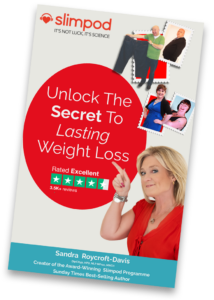
I’ve created a free ebook that explains why diets so often fail, how habits are formed, and practical ways to begin changing your relationship with food without relying on willpower or restrictive food rules. It’s practical, reassuring, and completly free.
How to Keep Weight Off After Losing It
One of the biggest myths about weight loss is that there’s a finish line. There isn’t, but that’s actually good news.
I’m not saying you’ll have to spend the rest of your life watching every mouthful or worrying about every meal – quite the opposite.
What I’ve seen over the years is that the people who successfully keep weight off don’t stay on a diet forever, they stop needing one. Their habits become so much more natural that healthy choices no longer feel like something they’re constantly forcing themselves to do.
That’s a very different way of living.
One Slimpod member put it like this:
“I have managed to maintain my weight this year with very little effort.”
For me, that’s what successful weight maintenance looks like.
Another member wrote:
“I can not remember a year in the last 38 where I’d have worn the same clothes one summer to the next.”
I love that because it isn’t really about clothes, it’s about stability.
It’s about finally stepping off the exhausting cycle of losing weight, regaining it and starting all over again.
I think that’s what most people are really searching for: not another stone lost, but a way of living that feels peaceful.
How to Keep Weight Off After a Diet
This is where I believe traditional dieting lets people down. Most diets have an end date.
You complete the programme.
You stop following the plan.
And, without even noticing, you often stop doing the very things that helped you make progress.
I’ve always thought we’ve made a mistake by treating weight maintenance as something that starts after you’ve lost the weight. But in reality, it should begin on day one.
It’s a bit like learning a new language: you can memorise enough phrases to get by on holiday. But unless you actually put it into practice, using it in your day-to-day life, those phrases soon disappear.
The same is true of eating habits.
If you’ve only been following rules, the rules eventually stop. But if you’ve changed your behaviour, your habits continue long after the diet has finished. That’s why I don’t believe lasting success comes from following strict rules forever.
It comes from becoming someone who no longer needs rules to make choices that support their health.
One Podder described it perfectly:
“Slimpod is not another fad but an ongoing new way of life.”
When I read comments like that, I know they’re talking about far more than weight.
They’re talking about freedom.
How to Keep Weight Off After Wegovy or Mounjaro
Weight-loss medications such as Wegovy and Mounjaro have opened up new possibilities for many people.
For some, they make it easier to lose weight by reducing appetite and quietening food noise, which can be incredibly valuable.
If you’re taking one of these medications—or thinking about discussing them with your healthcare professional—I see them as a tool that can create space for change.
One of the biggest opportunities during treatment is to build the habits you’ll want to keep long after the initial weight loss has passed.
How do you respond to stress?
What happens when you’re celebrating?
Do you notice when you’re comfortably full?
Can you trust yourself around food?
Those questions don’t disappear simply because appetite has changed. Many people describe having more mental space while taking these medications, and less food noise.
That quieter mind can be the perfect opportunity to practise new routines and strengthen healthier behaviours while they feel easier to repeat.
Whether you stay on medication long term or not is something to discuss with your healthcare team. But whatever path you choose, it’s the habits you build along the way that are most likely to help you maintain your weight in the future.
How to Lose Weight and Keep It Off During Menopause
If you’re in perimenopause or menopause, please don’t assume you’ve missed your chance.
One of the saddest things I hear is women telling me they’ve given up because they believe their body has changed too much. I don’t believe that’s true.
Menopause changes the challenge, but it doesn’t remove the possibility of success. Many women tell me they’re eating much the same as they always have, yet the weight seems harder to shift.
They’re sleeping less.
Feeling more tired.
Sometimes more anxious.
Sometimes simply unlike themselves.
Hormonal changes can affect appetite, sleep, energy levels and where the body stores fat, which is why menopause can make weight management feel more difficult. But difficult doesn’t mean impossible.
In fact, this is often the time when self-compassion matters most. Your body doesn’t need punishing, it needs supporting.
That means focusing on habits you can genuinely live with.
Finding enjoyable ways to move.
Prioritising sleep wherever possible.
Managing stress.
Eating in a way that leaves you feeling nourished rather than deprived.
And perhaps most importantly, letting go of the idea that every week has to be perfect.
I’ve seen women in their fifties, sixties and seventies make extraordinary changes. Not because they discovered more willpower, but because they stopped fighting themselves.
That’s why I believe it’s never too late to change your relationship with food.
Why Behaviour Change Creates Lasting Weight Loss
If you’ve taken one thing away from this article, I hope it’s this: keeping weight off isn’t about finding the perfect diet.
It’s about becoming the sort of person who no longer needs one.
That doesn’t happen because somebody hands you a better meal plan, it happens because your habits begin to change. You stop relying on motivation because healthier choices no longer feel like a constant battle.
When I first started working in behaviour change, I was fascinated by how quickly people blamed themselves.
If they regained weight, they assumed they’d failed.
If they couldn’t stick to a diet, they believed they lacked discipline.
But over the years I’ve realised something: people are remarkably good at following diets, until life gets in the way.
If your way of eating only works when life is calm and predictable, it isn’t really working for your life.
Behaviour change is different.
It helps you build habits that continue supporting you when life isn’t perfect. It’s about making enough small changes that one day you suddenly realise they’re no longer changes, they’re simply how you live.
One Podder captured that feeling perfectly:
“The word that describes my journey is ‘settled’.”
And perhaps the quote that sums up everything I’ve tried to explain in this article:
“After a lifetime of yo-yo dieting, I’m finally free.”
For me, that’s what success really looks like.
Why Slimpod Is Different
People often ask me what makes Slimpod different from the many other weight-loss programmes they’ve tried.
The answer is ssimple: Slimpod isn’t built around food rules, it’s built around behaviour change.
There are no foods you’re told you can never eat again.
No points to count.
No calorie targets to hit.
No feeling that you’ve been “good” one day and “bad” the next.
Instead, the focus is on changing the habits, beliefs and automatic patterns that influence your eating in the first place.
Because when those begin to change, everything else becomes easier.
That’s why so many of the comments we receive aren’t really about weight. They’re about freedom, peacefulness and finally trusting yourself around food.
One member told us:
“The weight loss is the smallest part of my journey!”
For me, that’s the biggest compliment of all.
Why You Can Trust This Approach
Behaviour change isn’t just the foundation of Slimpod—it’s the foundation of everything I’ve spent the last two decades studying and teaching.
Since creating Slimpod, I’ve helped hundreds of thousands of people change their relationship with food by focusing on the habits and behaviours that drive eating, rather than relying on restrictive diets or constant willpower.
The approach has also been used by NHS organisations and evaluated in an independent randomised controlled trial published in the British Journal of General Practice. The study found that participants using Slimpod lost significantly more weight than the control group over 24 weeks and also improved their confidence in managing their eating.
Add to that the thousands of conversations I’ve had with people who believed they had failed, only to discover that the real problem wasn’t a lack of willpower. It was that nobody had ever shown them how to change the habits underneath their eating.
Experience It for Yourself
Reading about behaviour change is one thing.
Experiencing it is something else entirely.
If you’re ready to stop searching for another diet and start building a healthier relationship with food, I’d love to invite you to try Slimpod free for 10 days.
It’s an opportunity to experience our behaviour-change approach for yourself and decide whether it feels different from anything you’ve tried before.
There’s no pressure.
Just the chance to discover what can happen when healthier choices begin to feel natural instead of forced.
Start your free 10-day Slimpod trial today.
A Final Thought
If you’ve spent years losing weight only to regain it, please don’t lose hope.
You’ve been trying to solve a problem that goes much deeper than food.
The encouraging news is that habits can change, I’ve watched it happen over and over again.
Not because people became more disciplined. But because they stopped fighting themselves and started working with the incredible way their brains learn new patterns.
Will there still be difficult days?
Of course.
But progress has always mattered more than perfection. So wherever you are today—whether you’re trying to lose your first stone or hoping this will finally be the time you keep it off—I hope you’ll remember this.
You don’t need another diet.
You need a different relationship with food.
It’s about building a way of living that feels so natural you no longer spend your life thinking about being on a diet.
And when that happens, you’ve gained something far more valuable than a lower number on the scales.
You’ve found freedom.
About Sandra Roycroft-Davis
Sandra Roycroft-Davis is the creator of Slimpod, a Sunday Times bestselling author and award-winning behaviour change specialist who has helped hundreds of thousands of people transform their relationship with food since 2010.
For more than two decades, she has studied the psychology of eating habits, weight management and sustainable behaviour change. Her work has been used by NHS organisations and evaluated in an independent randomised controlled trial published in the British Journal of General Practice.
Rather than focusing on calorie counting or restrictive diets, Sandra’s approach helps people develop healthier habits, reduce food noise and make lasting changes that feel natural, practical and sustainable.