You know that little conversation you have with yourself? “I won’t have anything sweet tonight.” Then dinner’s finished, you sit down, and there it is. “Just a little something.” Then suddenly you’re negotiating with yourself over a biscuit.
If that sounds familiar, then please believe me when I say you are not weak, and you are not failing. That constant, tiring back and forth around food is something I’ve heard about from thousands of people over the years, and it’s exactly the thing I’ve spent my life trying to help with. So let’s talk about why it happens, and how it can genuinely start to feel easier.
I discussed this in my recent YouTube video which you can watch here
Why is it so exhausting to constantly watch what you eat?
Knowing what you intended to eat doesn’t always change what you feel like eating. You can plan a lovely healthy day in your head, then come home after a stressful one and find yourself drawn to something else entirely.
That gap, between what you know and what you feel pulled towards, is exactly where the struggle lies. Constantly supervising yourself as a way to close that gap is absolutely exhausting, so it’s no wonder so many of us feel worn out by the whole thing.
Why do we reach for food on autopilot?
So many of our eating responses have become completely automatic. You put the kettle on and the biscuit tin opens as if by magic, you pick at bits while you cook, and something sweet becomes the full stop at the end of a hard day.
There’s nothing wrong with enjoying those foods, truly. The issue is that the response often happens before you’ve even stopped to decide whether you actually want it. You tell yourself “I must stop doing that”, and yet the very next evening, the same moment brings the same pull. That’s a well-worn habit at play.
Can healthier choices really start to feel more natural?
Yes, absolutely. Rather than relying on you to remind yourself what you should do, you can work on your habits and change what you instinctively feel drawn to do.
Now, don’t get me wrong, nothing magically burns fat while you sit still, but what does change is your automatic responses around food, and over time you might snack less on autopilot, feel satisfied with amounts that suit you, or fancy a walk. When those everyday behaviours shift, they can affect your energy balance, and that’s how changes in behaviour support changes in weight. It’s gradual, it’s real, and it’s so much kinder than fighting yourself.
Just picture it for a moment. Feeling happy to leave a little on your plate rather than telling yourself you’re not allowed to finish it, walking past the kitchen without that usual debate in your head, or getting to the end of an evening and realising you haven’t spent it thinking about food at all. Doesn’t that look wonderful?
What about the days it doesn't go to plan?
This matters enormously! If you’ve had a tricky evening and eaten more than you meant to, your old instinct might be to think, “I’ve ruined it, I knew I couldn’t do this,” and then everything gets abandoned until you start again on Monday.
I’d honestly love you to try something different. Look at what actually happened. Were you hungry? Overwhelmed? Had you spent the whole day running around after everyone else? You can learn something useful from the situation and just carry on. One evening doesn’t have to become a verdict on you.
Also, please do notice your small wins, the ones that the scales never show. You enjoyed a meal without rushing, you realised you’d had enough, or you had a stressful afternoon and recognised that what you really needed was a break, not a biscuit. Those little moments are where the real change is built.
What I really mean by taking the hard work out of it
When I talk about making sustainable weight loss feel easier, this is what I mean. Less fighting with yourself around food, and making room for more of that confidence to shine through.
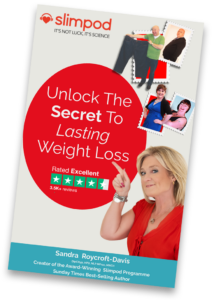
I’ll always be straight with you. There’s still a process to engage with, and weight maintenance is also shaped by biology, health, and circumstances as well as habits, so no one can honestly promise you’ll never regain. But I created Slimpod to support exactly these everyday responses, behaviours, and that all-important confidence, because after all these years, helping people feel free around food is still the thing I care about the most.
If you recognise that feeling of knowing what to do but wishing it felt easier, I genuinely hope this has helped it make a little more sense.
If you’d like to try Slimpod you can start your 10 day free trial here.